
Woodbury Roof Insurance Claim Timeline: Week-by-Week Guide
“How long does this take?” is the question every Woodbury homeowner asks within the first ten minutes of filing a Sept 21, 2025 claim. Honest answer: it depends — but the typical residential hail claim follows a predictable arc, and once you know the arc you can plan around it instead of waiting on hold.
Here’s the realistic week-by-week timeline of a Woodbury hail claim, what’s happening behind the scenes at each stage, and how to keep your claim moving efficiently before the September 21, 2026 bar.
Week 0 — Day of the storm and the next few days
If you’re reading this and the storm just hit, the first 48 hours are about safety and documentation, not about filing claims:
- If you have an active leak, mitigate it (buckets, tarps, call for emergency tarping)
- Photograph everything you can see from the ground
- Save any debris or damaged property pieces
- Note the time and date of the storm
- Don’t file a claim yet — get a contractor inspection first
Week 1 — Contractor inspection and claim filing
- Day 1-3: Schedule a free contractor inspection (Owl gets you on the calendar within a few business days post-storm).
- Day 3-7: Inspection happens. You receive a written photo report.
- Day 7-10: Call your insurance company, file the claim with your contractor’s report ready to send.
The contractor inspection-first approach is important. If you call your insurer with “I think maybe there’s damage,” that goes on your record as a soft claim. If you call with “I have documented hail damage from Sept 21 and am filing a claim,” that’s a position of strength.
Week 2 — Insurer acknowledgment and adjuster scheduling
Under Minn. Stat. § 72A.201, your insurer must acknowledge your claim within 10 business days of receiving notice. Acknowledgment usually happens by phone or email and includes a claim number.
The adjuster typically gets assigned within this window. They’ll call you to schedule the inspection visit. Schedule for a date when you and your contractor can both be on-site.
Weeks 2-4 — Adjuster inspection
The adjuster shows up. They walk the roof, document damage, measure elevations, and head back to their office. Within a few days to a couple weeks of that visit, they produce a scope and a coverage decision:
- Scope of repair — what they’re authorizing to be replaced/repaired
- Estimated cost — how much they’re paying
- Coverage decision — approved, denied, or partial
- Initial check (ACV) — actual cash value of approved scope minus your deductible
Weeks 4-6 — Reviewing the scope
You and your contractor compare the adjuster’s scope against the actual damage. Common findings:
- Adjuster’s scope is missing line items — supplemental needed
- Adjuster only scoped one slope when multiple are damaged — supplemental for matching
- Code upgrades not included — supplemental for code compliance
- Soft metal damage missing from scope — supplemental for gutters/AC/vents
- ACV check arrives — you confirm you’ve received it
If the scope is reasonable, you sign with the contractor and the work goes on the schedule. If it’s missing items, supplementals get drafted and submitted.
Weeks 6-10 — Supplemental claims
Supplementals are submitted with photos, code references, and updated scope items. Insurers respond within their 72A.201 timelines. Most supplementals get approved with proper documentation.
If the supplemental gets denied, you may appeal, request supervisor review, invoke the policy’s appraisal clause, or escalate to the MN Department of Commerce.
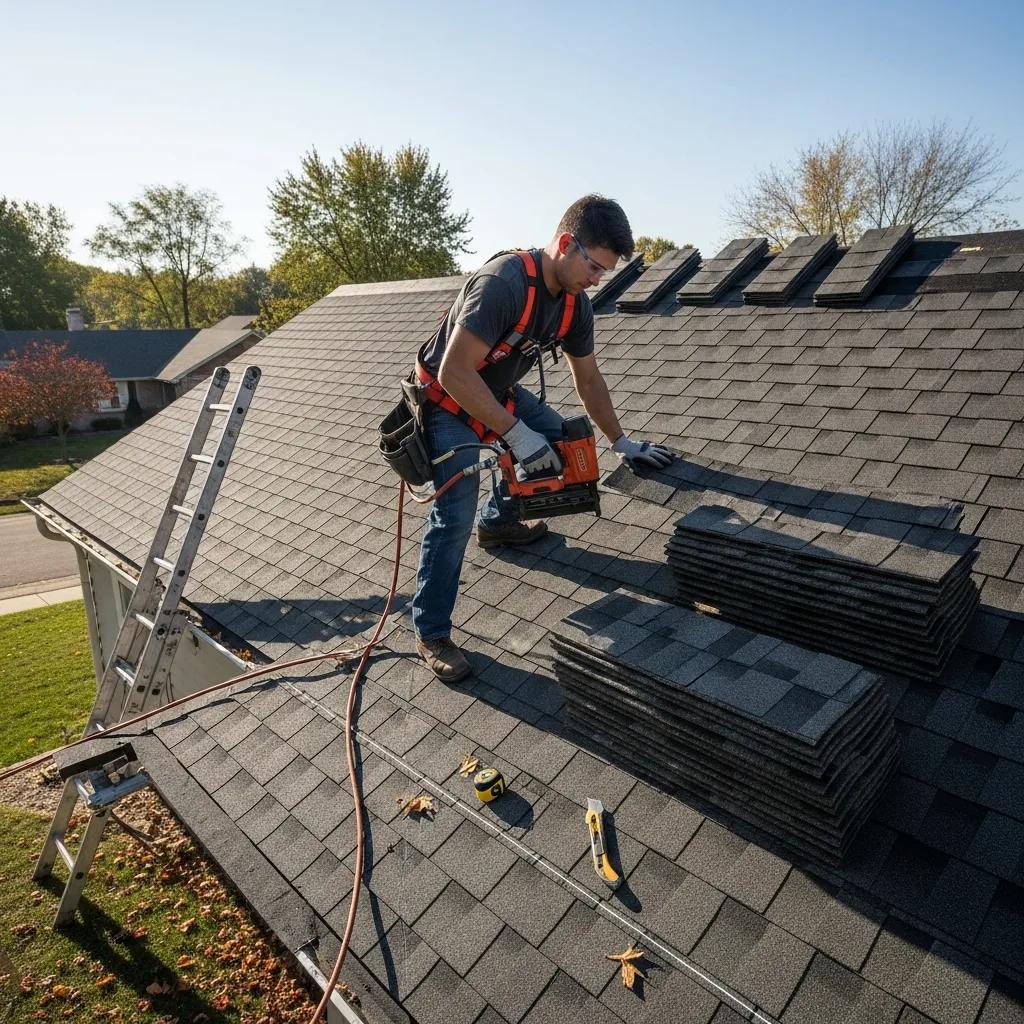
Weeks 8-14 — Production scheduling and roof installation
With approved scope in hand, your contractor schedules production:
- Materials ordering — typical lead time 1-3 weeks for asphalt; longer for specialty
- Permitting — Woodbury permits typically issued within 1-3 business days for a roof replacement
- Production date assigned — usually 2-6 weeks out depending on backlog and weather
- Tear-off and installation — 1-3 days for most residential roofs
- Final inspection — by the city building inspector and your contractor
This is the most weather-dependent part of the timeline. Spring rain, summer storms, and winter snow all delay production. Roofs go on year-round in Minnesota with appropriate adhesive activation, but production windows are easier in late spring through early fall.
| Phase | Typical duration | Critical milestones |
|---|---|---|
| Pre-claim documentation | 1-2 weeks | Inspection, written report |
| Claim filing & acknowledgment | 1-2 weeks | 10 days under 72A.201 |
| Adjuster inspection & scope | 2-4 weeks | Walk + scope writeup |
| Supplemental claims (if needed) | 2-6 weeks | Per supplemental cycle |
| Materials & permitting | 1-3 weeks | Lead time varies by material |
| Production & install | 1-3 days | Weather-dependent |
| Final inspection & RCV release | 2-4 weeks post-completion | Recoverable depreciation paid |
Total typical timeline: 10-20 weeks from first inspection to RCV-paid completion.
Weeks 14-20 — Final RCV depreciation release
Once work is complete and verified, the insurer releases the recoverable depreciation portion. This is the difference between ACV (paid up front) and RCV (replacement cost value), and it makes you whole on the claim.
To get the RCV release, the insurer typically requires:
- Final invoice from the contractor
- Proof of payment (or proof of work completion)
- Sometimes a sworn statement or final affidavit
- City permit close-out
This step is mostly paperwork. The contractor usually handles it on your behalf as part of the project.
“Worked with Noah and it was a great experience. He was very responsive to any questions I had. Good team did a great job getting the roof replaced.”
— John Wharton, Woodbury homeowner (Google review)
Things that speed up your timeline
- Get the contractor inspection done first — saves a week+ of back-and-forth
- Use a contractor that handles supplementals as part of the job
- Have all documents and photos organized in one folder
- Respond to insurer requests within 1-2 days
- Sign the contractor agreement promptly once scope is approved
- Choose stock material (most common shingle colors and brands)
Things that slow your timeline down
- Filing the claim before getting a contractor inspection
- Choosing a contractor who doesn’t handle supplementals
- Specialty materials with long lead times
- Scope disputes that go to appraisal
- Bad weather windows during production season
- Holidays and slow weeks (late Dec, mid-summer construction lull)
What to do if your claim is taking too long
- Document the timeline yourself — when each milestone happened
- Reference the 72A.201 response windows in writing
- Ask in writing for status updates (creates a paper trail)
- Escalate to a supervisor if the adjuster is unresponsive
- File a Department of Commerce complaint if delays persist
- Watch the September 21, 2026 deadline — escalate before you run out of buffer
Other Owl posts in the storm cluster
- Woodbury Roofing Guide (pillar)
- The Sept 21, 2026 deadline
- Appealing denials
- Adjuster vs roofer
- Storm damage service
What Woodbury homeowners say about Owl
★★★★★
“Noah is the real deal. After our insurance denied our roof claim and the first roofer walked away, Noah showed up the next day and said he thought he could get us a new roof. He came through. I call him The Roof Whisperer.”
— Tyler Moberg, via Google
★★★★★
“It wasn’t an easy process as my insurance company initially was only paying for a handful of shingles, but he eventually got them to pay for the whole roof.”
— BBB Verified Customer, via BBB
★★★★★
“Noah did an excellent job with our roof and windows, and the entire experience was straightforward from the beginning. He communicated clearly, showed attention to detail, and delivered high-quality work. His team was efficient and professional throughout.”
— Brian Edge, via Google
All reviews verified from Owl Roofing’s public review profiles. See more at our reviews page.
Frequently asked questions
How long does a typical Woodbury hail claim take from start to finish?
What’s the longest part of the timeline?
Can I rush the timeline if I have an active leak?
What if my insurer is taking longer than the 72A.201 windows?
Is winter installation possible in Minnesota?
Do I need to be home for the production work?
Get on the schedule before backlog hits
Free Woodbury inspection, claim coordination, supplemental handling, and a roof finished before the September 21, 2026 bar. Call (651) 977-6027 or request below.
